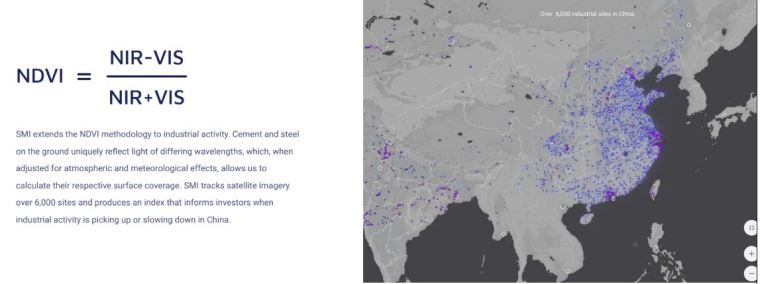
This simple equation below is complex #oxymoron. But hey, according to the real renassiance man, Leonardo da Vinci said “Simplicity is the ultimate sophistication.”
Detailed PDF attached. This below:
“SMI extends the NDVI methodology to industrial activity. Cement and steel
on the ground uniquely reflect light of differing wavelengths, which, when
adjusted for atmospheric and meteorological effects, allows us to
calculate their respective surface coverage.
A lot of economist / investors have always question China’s official 6.5% annual GDP #. So this company used their satellite data to track per the methodologies above and find (accordingly to this company) the most recent China’s official GDP # is questionable.
BUT I think they have to (1) track it over a long period of time BECAUSE China’s economic structure base is drastically shifting from a pure manufacturing based to high tech manufacturing and consumption based economic output. “High-tech” manufacturing is defined as the biotech and medical equipment, cranes, passenger planes, and the juiciest of them all, the semiconductor industry. High-tech manufacturing typically requires less raw material inputs / more raw knowledge equity input comparatively speaking so analyzing reflectivity of heat and light might not provide the best recommendation. Some things that is happening in front of our eyes but below the mainstream media interest:
- Chinese Yuan-based government bond will start to get auctioned (like US Treasuries weekly auction) via Hong Kong. Hong Kong is one of the best gifts China can utilize to (1) deleverage the country’s high debt, but more specifically, high domestic-currency dominated debt. (2) Hong Kong Dollar is pegged to USD with a currency ceiling, which has been hit several times this year so the HKMA (Hong Kong Monetary Authority) basically burned the country’s currency reserve to hold the FX rate steady. Next week week of Nov 5, 2018, $30B worth of RMB-based debt will get auctioned in Hong Kong. It’s a good way to test how open or fast should their open up their domestic financial market to foreigners.
- By creating foreign demand for Yuan-based government bond basically allows China to (1) exponential increase their credit base aka they can basically borrow more to fuel their economic and financial growth.
- China is signing direct currency swap contract with countries, which is basically a very direct way to bypass the USD which will structurally speaking weaker global demand for USD, starting with The Philippines, Japan and Indonesia. The latter two country will be the top 5 economic power within the next 10 years. Indonesia specifically, as they have the top 3 highest population in the world (growing consumer purchasing power) with decent internal political and economic stability, not to mention they have a pretty higher mobile penetration rate given how comparatively small the country is to other developed markets.
- The scale of the currency swap right now is still very minimal, we are talking about ~$50B at most, whereas ~ $1.5 trillion USD of FX contracts are traded EVERY single day today.
- The currency swap basically help those “emerging markets” weather the current strength in the USD, whereby, a EM country borrowed $100 USD @ 10% interest rate. But they interest rate payment is coming from EM Country’s domestic currency. So the strengthening of USD basically weakens, comparatively speaking, the EM’s country’s currency (aka they need more domestic currency to buy $1 USD)
- I don’t think the other countries will bet 100% of their currency reserve in RMB Chinese Yuan, probably a mixture of it. The reserve ratio of other central banks could also be heavily dependent on the trade activity (i.e. countries > 60% of their trade coming from China will likely have higher RMB in their reserve)
- Shanghai Crude Futures – China launched RMB-based crude futures…basically China consist of the majority of the incremental oil demand post 2008, we control the supply side since 2008. Which has bigger implications? Supply or demand. I think whoever controls the supply has more medium-term upside as you can flex the price of the raw material more. Those who control demand has to worry about growing oil price inflation for their domestic population (which if inflation becomes out of control creates instability in the society which creates fear in the investment market).
- Brent = mostly Euro / London crude futures // 16% of world oil trade
- WTI / Western Texas = mostly US-based crude futures // 8% of the world oil trade
- Shanghai = I think China is aiming to create one for SE and E Asia // 6% of world oil trade. The scary part is this was 0% just in June 2018.
Global Currency Reserve and The Roman Empire’s Military Formation Strategies
All is all, I think the PBOC // akin China’s Central Bank is doing a lot of smart things right now to set up the base for the long-term game beyond just piling on incremental debt (leverage) capital into their economic system, which will likely cause hiccups in the short-term. But Chinese Yuan RMB is still a ways (probably at least 3-4 decades away) to go from becoming a global currency reserve or basically financial spheres of influence, which often comes with military, economic spheres of influences as well. I am more interested in the 2nd layer downstream countries and major industries (which for most of these EM’s are still government-owned), but sub-industries that will reap the benefits of this i.e. incoming Growth of Insurance Tech Startups in Emerging Market.
- Just look at the British Empire, they have the best Naval Force of their global dominance period. Not to mention the former British colonies that continues to be the top 5 most prosperous countries in the world, namely Singapore and Hong Kong
- The City of London (which has some unique independent history) not the “city of London” but rather the “City of London” a special jurisdiction within the city that controls financials including the almighty LIBOR rate and the protection of the “trust entity” in Cayman Islands + Mauritius etc. which like the old saying in the business world, “accountants will actually be your best friend when you reach some level of capital level”.
- The Romans are not only known for their financial and economic might but also their military brilliance, especially the formation of legions. Reading military tactic books goes beyond just military, you will understand how to deploy labor / human, financial and knowledge capital in times of dire / limited OR abundant / fruitful situation. The one that stood out to me is the following, which can be analogized to modern business decision making: https://romanmilitary.net/strategy/legform/
- “If your forces are few and weak in comparison to the enemy, you must make use of the seventh formation and cover one of your flanks either with an eminence, a city, the sea, a river, or some protection of that kind.” When the Romans were outnumbered or had inferior troops, this was often the only hope for victory. The left flank was kept guarded by whatever protection was available. The right was protected by the light troops and cavalry. With both sides well covered, the army had little to fear from an attack.

 Intersection notepad