Decided to write a quick piece on my flight back to Austin from a Venrock x Plato product mentorship event in June 2018.
Most consumers and public equity investors know Amazon via Amazon.com, AWS (margin creator), logistical networks (owning Prime planes and 1000’s of trucks) and soon their marketing ad products, but not many know or have read reports about their strategic investments in the insurance tech product offerings in SE Asia. As of 2018, the company is definitely no stranger to selling financial products to customers, albeit their mini learning experience / lesson from selling student loan offerings to Amazon Prime users, in close collaboration with Wells Fargo.
The stunt was short-lived but I am sure has offered an abundant experience in how to collaborate with financial institutions as well how to craft to story and product offerings to avoid the backlash from the media. But on that note, Amazon has deployed a small handful of capital into the insurance tech startups in India and other parts of SE Asia.
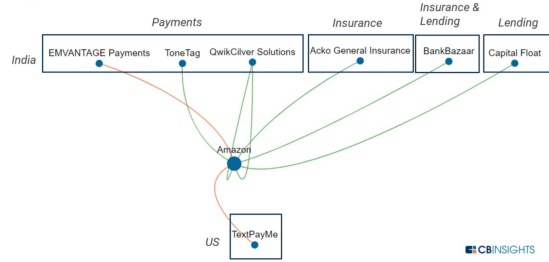
We all are probably no stranger to insurance products, especially those of who are here in the US, as everything that can be commoditized and insured has been insured, ranging from the common auto, property and life insurance (which to my estimate is > 80% of all premiums collected in the country every single year, excluding ‘insurance’ equity, derivatives and other pure financial products). Now I will dig deeper on the implications of Amazon’s and other corporate ventures’ investment in insurance tech startups have on not just corporate ventures themselves but also the financial and social systems in those countries.
The Real Revenue Stream of Insurance Companies. On the top level, insurance companies can typically create revenue via two avenues:
(1) Arbitraging the variance between premium collected versus payout. This is pretty self-explanatory, and on top of that, insurance pricing mechanism and output is very inefficient and opaque, in a way you can just compare an insurance offering from insurance company A to that of insurance company B. Another contra example of relatively transparent pricing mechanism is the TV industry. You can easily compare the price of a TV from tv manufacturer A to tv manufacturer B, thanks in great part due to the proliferating of info and access to such tools. Also, the comparative variables are a lot less complex (it’s 4K versus 2.5K versus 8K quality and TV dimension is also pretty self explanatory).
(2) Investment Gains (Losses) via investing premium collection. This is perhaps the real bread-and-butter of the insurance companies, but also why play substantially more vital role than what the media and the general public thinks. Global insurance companies manages 10’s of trillions (yep with a “t”) in assets and deployable capital. But on the flip of this opaqueness in insurance company public reporting needs is the danger of investing in risky assets or equity relative to the downside risks (default, delinquency risks, market risks, interest rate risks etc.) due to the compression of yields all around the world.
Why Most Developing Countries Will Soon Experience Growth in Insurance Products
Besides the incoming volatility in the EM / developing countries in 2H of Q2 2018 and might as well be for the ROY 2018, in great part due to the currency volatility creating contagion to other equity and debt volatility in those respective markets. One good example is the current currency volatility (and thereof, inflation as well) in Argentina, Turkey and other EM markets, in some parts can be attributed to the strong upswing and downside in USD [given some are partially or fully pegged to USD]. HKD is another that is forcing the HKMA (Hong Kong Monetary Authority) to step in to intervene to avoid the HKD from overspilling over their pre-mandated USD pegged rate.
But EM (emerging market) currency volatility aside (which has yet to create spillover effects on the equity and debt volatility as of today), EM still presents a very solid growth story in the long-term, and even more so from the insurance tech companies and startups in those countries.
The thesis on the incoming growth factor of insurance products (therefore insurance tech startups) in EM is:
As middle class continues to grow in % and absolute term in EM, there will be more and more demand for security and safety (psychologically, most middle class cannot afford to think or actually lose their hard-earned assets and equity they have accumulated throughout the years), therefore such demand will drive startups and traditional banking institutions to create more and more insurance products to cater to asks.
The well-capitalized class in almost all 21th century societies use insurance as a downside risks management. The middle class (and growing) will utilize insurance products as a mechanism to product their hard-earned assets (a form of downside though decision-making process behind purchase of insurance products could vary to other classes).
As the growth factor of middle class continues to outpace that of the upper and lower class in absolute term (assume the denominator continues its linear growth, that is demographics continues to trend positively. One thing to note is most developed countries are experiencing or will soon experience demographic growth plateau, some even going through relative declining population growth), the demand for insurance products will continue to growth.
But it is very worth noting the banking regulators of these countries to really put a careful scrutiny on the risks associated with these products. I think it’s vital to have insurance products in any financial system of the 21th century, but the opaque investment reporting standards in general and opaque insurance products will inject a lot of inefficiencies in the overall financial markets (aka lots of new capital from the consumers are essentially being redeployed back into the equity / debt financial systems).
Insurance products as a whole can and should be categorized as a systematic risk class of its own, especially in emerging markets. This should be handled in parallel with the growing maturity of these EM’s financial markets as a whole. But on the flip side, I, whether it be from the perspective of investor and/or operator, has great potential and potential return given the points above.

 Intersection notepad