Starbucks is one of those very small handful of companies who have done a great job at creating and keeping their customers, and potential customers thereof as well, in their ecosystem through their app. It is one thing to create an app (most chain stores have already created their own apps by now as of Q3 2019 though most did theirs more recently albeit the still have one).
Starbucks app is unlike other food chain’s apps in that they consolidate ordering, promotional push and store of value inside their app ecosystem. As the more recent saying goes, all companies will sooner or later become a fintech app because that’s how you get closest to your cashflow / revenue source (your customer’s bank account) but Starbucks took this even further by creating a ‘bank account’ like interaction within in which their customers can store and redeem value.
Here comes the more impactful area of this strategy – Starbucks currently (as of the latest 10Q earnings report) has ~$1.60 billion in stored value card liability, which in layman term, means is the sum of all physical gift cards held in customers wallets. This essentially means their customers are lending $1.60 billion to Starbucks HQ at 0% zero interest.
This strategy by itself is nothing new as companies like Square, Stone Ltd, Venmo and other payment companies essentially take their customers store of value (cash saved in their own wallet) and invest in low-risk Treasuries. The main difference between their wallets and that of Starbuck’s is the ability for the customers to realize liquidity. Square, Stone and Venmo’s customers can realize liquidity in an instant with a push of a button (the liquidity can be pulled in and pushed out of their ecosystem in a matter of seconds) whereas in Starbuck’s case, customers can only use the wallet to purchase more drinks which essentially contributes to Starbucks top-line rev…
.The benefits of having a closed transaction ecosystem like that of Starbucks is two folds (1) parent company can borrow against customers wallet balance @ 0% interest rate and (2) they can save on average 1-3% in credit card transaction fee that they would other wise have to pay if customers use their credit card to purchase…so this ecosystem not only impacts the top-line (revenue) but also the bottom-line (credit card service fee) as well as the balance sheet liquidity.
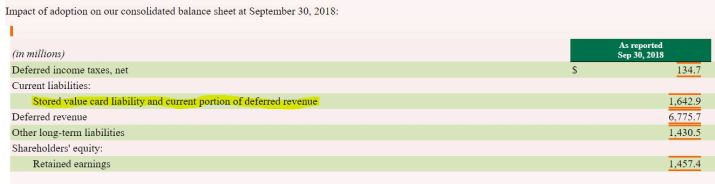

https://www.sec.gov/ix?doc=/Archives/edgar/data/829224/000082922419000036/sbux-6302019x10xq.htm

 Intersection notepad