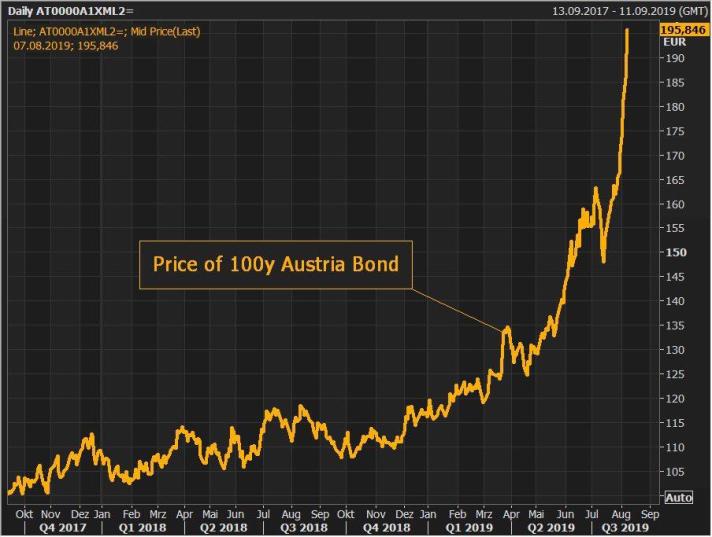
As the global banking system continues this trend of further benchmark yield compression close to and/or below zero % yield, it’s worth thinking about the implications the importance and direction of holding long-dated government bond as a portfolio diversifier. My take on this whole global yield compression is (1) we will likely continue to go into the negative yield zone (layman term: savers will pay to save $ in their bank account, which is different than the traditional model we know of saving $ to get some slight interest gain).
The key to this thinking is relativity – as Euro bonds continues into the [0%, -2%] interest bond, the 10Y Treasury should be able to be compressed to [0%, 1%] range, and this interest rate relativity is possible mainly because of reserve currency status. And the net short-term effect of this interest rate differential b/w Euro bond and Treasury will likely direct substantial capital flow into the US capital market. Though on the Euro bond side of the equation – there is likely a lower bound limit because for example, when ECB lowers than rate to -3% (negative three percent interest rate) the savers will likely withdraw the cash and stack them ‘under their mattress’ b/c this essentially means for every $100 EUR you save in your bank account every account, you need to pay $3 to keep it there, which is essentially a deflationary direction. In fact, some European banks are offering vault storage with physical cash management.
Which ultimately pardons the question – how effective will long-dated government bonds at providing a mean of diversification in your portfolio. Here are some investment theses worth considering:
- Highly abstracted market securities will be very disappointing. Even somewhat abstracted securities (ETFs) won’t work nearly as well as they have. You’ll need to get closer to real-world cash flows.
- Real assets will matter a lot, but in a modern context. Meaning that I’d rather have a fractional ownership share in intellectual property with powerful licensing potential than farm land.
- pricing power – Low Inflation Dynamic Favors Business with Pricing Power
- When everyone has nominal revenue growth, business models based on profitless revenue growth won’t get the same valuation multiple. More generally, every business model that looks so enticing in a world of nominal growth scarcity will suddenly look like poop.
- The continued perceived ‘omnipotence’ of Central Banks across the world will likely get challenged further. We started with buying/selling domestic government bonds to manage volatility and the credit creation process, but I think we are starting to heading into an era where CB’s will start to purchase private assets – i.e. buy us the equity of a private company. Though there is no doubt the Global Central Banks will likely continue to maintain their heavy influence across the global capital and financial market.

 Intersection notepad