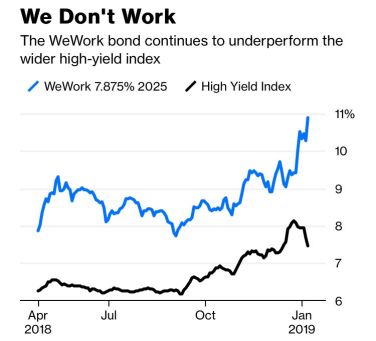
Just to add a bit more on the credit side of the story. Even though credit spreads have widen considerably since Q4 2018 (we did not see this type of widening in Q1’18, but saw a little bit of it in Q1’16) WeWork’s bond spread continues to widen substantially relatively. Credit market often times provides a more directional guide, even amidst a very covenant-lite and high % of triple B bond issuance (one layer above junk bond, one step away from becoming “fallen angels”).
Also worth a read is Fred Wilson of Union Square Ventures latest take (available on his blog) on the potential incoming convergence of private valuation and public market expectation, especially given 2019 will be the years of IPO (Robinhood, Airbnb, Uber, Lyft, Slack, Instacart, Palantir, Postmate, Pinterest, Didi, and DJI also planning/going to list). Though not all is lost in the private market, that is as long as mgmt team is consciously
Also, given the low entry barrier, capital raise then becomes more crucial, but more importantly, this is one of many reasons why there is such a localized and regionalized fragmentation going on in the coworking space. Google coworking in your town and you will find at least 10-20 other big and small brands just inside your city. This dynamic will likely continue to be the case give the variables above and high price sensitivity of local customers base.
I supposed their “community” is one of their competitive moats, hence the “community-adjusted EBITDA” metric. Though the global flex office perk is a good one! Unit economics on a per building basis is good (tranching the rental space up to squeeze more rent on $/sq basis) just not sure if it’s scalable across market-wide since it’s extremely capex and leverage heavy.
But they supposedly underwrite their project to withstand at least 25-40% drop in occupancy rate and still maintain breakeven cash flow.

 Intersection notepad