Studying the patent portfolio and patent pending filings can help present a decent gauge of not just the corporate strategy of corporations (and to some extend, the types of startups that will be build in the future as in an ‘efficiency market’ or shall I say, knowledgeable market, startups are created to cater to an ‘inefficiency’ in the current market conditions and consumer behavior profile). One of the things I study on my weekend morning coffee break is the the current patent and/or patent pending portfolio of corporations as it:
- Top-level directional guide to how US consumers and businesses will shop for goods and service (or at least from their perspective, which might be always be right, but might increase the likelihood of potential acquisitions within the next 3-5 years to come), which is especially useful if you are a venture capitalists (typically speaking, are essentially utilizing capital from source to create more capital/return within a 5-year time frame) unless you are like that of Chamath Palihapitiya who is is coming up with a longer 5-12+ year venture capital liquidity/liquidation time frame with his “blank-check’ IPO concept as annotated in my other posts.
- Corporate strategies that aligns with the intent of protecting their existing and future product pipeline strategies – which is always fascinating by itself as history have show that corporate strategies of the major/publicly-traded corporations could, to some degree, have a slight variance to what the consumer is actually looking. But as is the case for all extrapolation based on historical data, hindsight is to a large extent, 20/20.
Since Amazon is considered the godfather of ecommerce in the US, one can safely assume its worth studying their current and patent pending portfolios today. One of the key areas and perhaps opportunities, that fascinates me is the shorter and shorter supply chain consumers are demanding, meaning consumers now expects to receive their product from a week to 3 days to 1-2 days via AMZN Prime to now 1-2 hours in a small handful of US zip codes (and a relatively large portion of zip codes in China)
The shorter and shorter consumer product demand cycle gave rise to the likes of companies who have popularized the concept of ‘fast fashion’, with leaders like H&M and Zara, which were considered unbeateable just 3-4 years ago as consumer demand for their product is through their room; one might attribute this to the growing demand of instant gratification in some parts due to social media. The general concept of ‘fast fashion’ allows consumers to experience and purchase a product style that will change every month now versus that of 3-6 months back in the ‘Ralph Lauren’ days.
From the VC and Chief Strategy Officer’s perspective, it allows a relatively high ‘recurring’ purchasing behavior on the revenue contributor end of things but the downside is the limitation and constraint on the supply chain side of the equation, as this new strategy only allows relatively horizontal economic of scale rather than that of vertical; meaning the the real scale from the startup and the companies’ ability to scale to new locations (therefore capture incremental new demand) rather than vertical or fully deplete the demand in a relatively small handful of locations.
With that being said, Amazon and the likes of other ecommerce companies have just got approval for a patent that allows them to shorten the supply chain and as a result, the production discovery and product distribution cycle, and that is done by incorporating the production components of the supply chain directly into the distribution vertical. Below are some key components of their patent filings: USPTO Link.


if you are a relatively high-risk venture capitalists (as we don’t get the luxury of the balance sheet and financial statements to use as the basis of your investment decision-making basis), I think it’s worth study the current patent and patent pending portfolio of these corporations (think corporate venture capital arm establishment) as one of the several variables in evaluating the opportunity in front of you.
Conclusion –
There are capital investment and debt financing implications b/w how close a company place their product distribution channel relative to the source or supply of raw materials; typically speaking, the closer any company places their production/upstream production channel to that of consumer distribution channel, the relatively more compressed their margins typically are in the long-term in an efficient marketplace (efficiency can be defined as the barriers to entries and/or competitors supplies), or in say it in another way, companies need to put a real tight watch of their margin.
Though not a pure dichotomy, the relatively medium/long-term brand loyalty which this strategy allows (it allows consumers to get what they want in a relatively short period time/instant self-fulfillment psychology), allows the company’s mgmt team to capitalize on the brand value and brand equity…
as well as the recurring revenue component of the equation on the long term (not to mention the declining relative customer acquisition costs side of it as a sizable portion of the revenue acquisition cost is now essentially being shouldered by brand value [
company building aside, I am not a big value of brand equity recognition on the balance sheet on publicly-traded companies because anyone can essentially say their brand value is worth $10B without much statistically basis behind it. Look at Ferrari who just did an IPO a few quarters ago, which by the way, is still 80-90% family-owned meaning if you are essentially owning a darn minor minority as a public shareholder and their balance sheet is packed with ‘brand equity’] Don’t get me wrong, I am a fan of the Ferrari cars but the financials might perhaps paint a different direction.
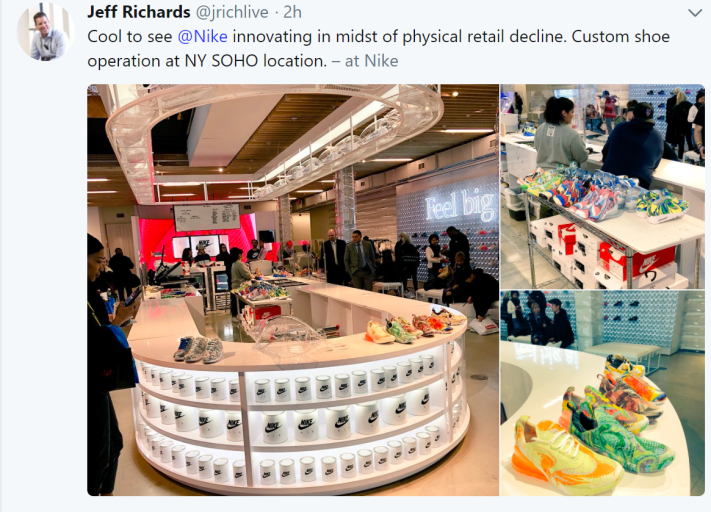
Nike is doing a test-run in their flagship NYC store:

 Intersection notepad