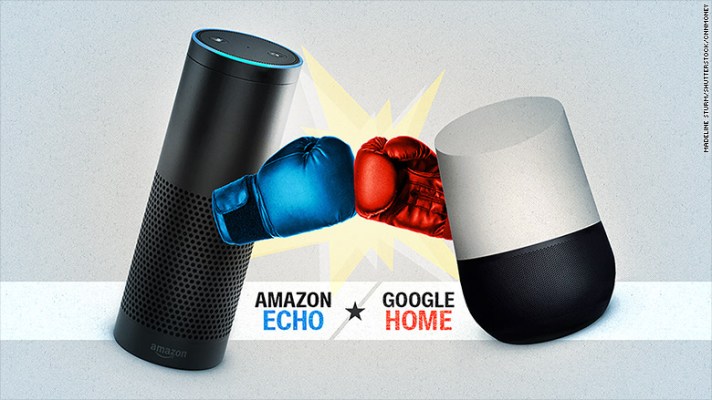
Voice technology is starting to become a crowded space as tech behemoths are starting to enter this area one by one, starting with the success and wide adoption of Amazon Echo. A few days ago, Google also followed the footstep with the announcing of the voice-enabled Google Home. I am sure companies like Sony, Samsung and Google will also step up their involvement in the coming months. The question is why incorporate voice enablement in technologies?
Speech is the ultimate invisible computer interface. In the next 10 years more than 50% of computer interactions will be via voice. The computer, the device and the legacy interface will disappear, all that will persist is the volition, intention, interaction and results.
Speech also requires less mechanical load and cognitive load. The most powerful and efficient interface for communication is the human voice. It sounds obvious in this context and it has had a few million years of evolutionary development. Yet we take speech quite for granted as we only recently took to a mechanical system (typing, clicking, pointing) to interact with computers. Human speech is a far more refined tool that can convey densely packed instructions and requests in-situ more effectively. The mechanical load and cognitive load on the human is far lower when we can utter a phrase like “Alexa, what does my commute look like?” as compared to the countless cognitive and mechanical steps when using smartphone apps.
The ultimate benefit of embedding voice in the interaction with technology is the ability to scale down to much smaller and cheaper resource deployment for (1) App/Website UX will not be needed and (2) all maintenance and update can be streamline via one single piece of technology (Amazon Echo for example).
“Speech based interfaces allow you to multitask and do other things. Unlike the paradigm using a device and reading a screen, using your voice is liberating and increase productivity to an extend simply not possible with mechanical interfaces alone.”
The computer as we know it has been shrinking and in many ways will disappear and become a nexus connecting us via speech. Voice interfaces will continue to grow and supplement the experiences we consumers have and need with screens and VR.

 Intersection notepad